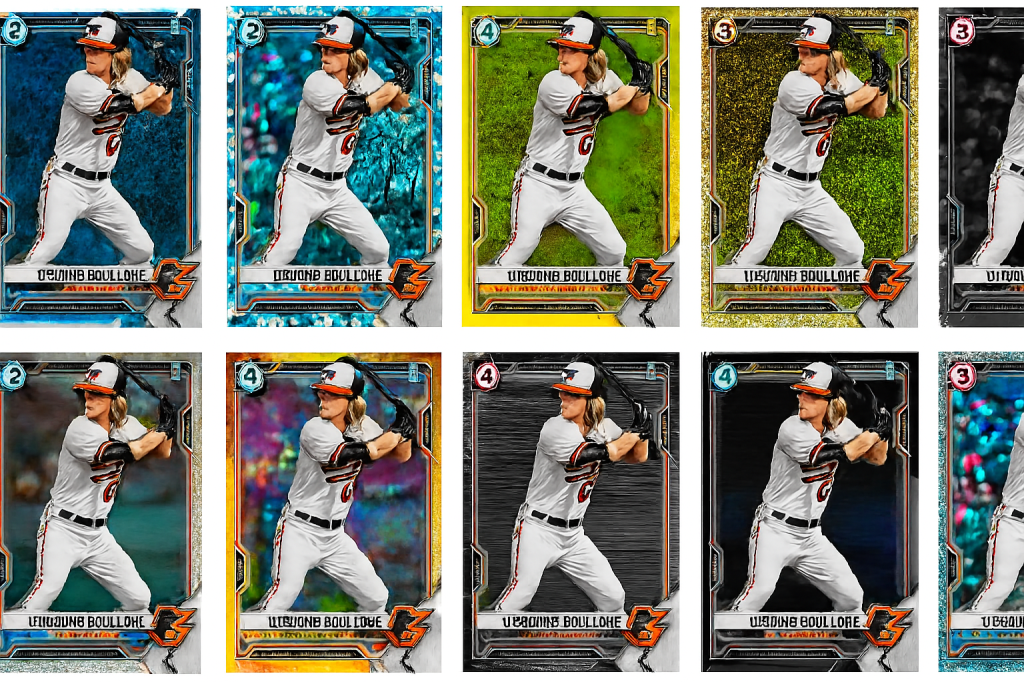
A few days ago, I wrote about leaving the frustrating world of Star cards. My reason was simple: when a company’s rarity can’t be trusted, it’s not rarity at all—it’s just a game. The hobby, however, has found a new way to play that game. Numbered cards still matter. I’m sleeving them. I’m top-loading them. I’m not pretending they’re junk. But let’s be honest—when base cards spawn what feels like a dozen different parallels, the chase starts to feel less like a hunt for treasure and more like a color-coded shell game.
The Color Parade
The frustration with modern card collecting is the sheer volume of parallels. What was once a simple set with a few variations has exploded into a full-blown rainbow of color and patterns.
Here are some confirmed examples of the types of numbered and non-numbered parallels you’ll actually encounter in a modern Topps or Bowman release:
Bowman / Topps Chrome Parallels:
- Refractor (non-numbered)
- Speckle (/299)
- Purple (/250)
- Blue (/150)
- Mini-Diamond (/150)
- Green (/99)
- Yellow (/75)
- Gold (/50)
- Gold Shimmer (/50)
- Orange (/25)
- Orange Shimmer (/25)
- Reptilian Orange (/25)
- Black (/10)
- Black X-Fractor (/10)
- Red (/5)
- Red Lava (/5)
- SuperFractor (1/1)
- Printing Plates (1/1)
And that’s just a slice. The same player might have a Gold Refractor (/50), a Gold Shimmer (/50), and a Gold Lava (/50) all in the same product. It’s not collecting—it’s sorting.
Scarcity vs. Fragmentation
A /25 is still a /25. But when it’s one of several different /25s for the same player in the same release, the impact gets diluted. You’re not pulling junk—you’re pulling slivers. And when a box guarantees numbered parallels, the thrill starts to feel padded.
The real prize isn’t just a low number—it’s a low number that feels special. A 1989 Topps Tiffany Ken Griffey Jr. rookie isn’t just valuable because of its limited print run; it’s valuable because it’s a single, distinct variation that was an intentional chase. Today, that same card might have 20 different versions, each slightly different, each fighting for attention.
Where I Stand
I still collect. I still sleeve. Numbered cards get top-loaded, no question. But most of them? They go in the box. Protected, sure—but not celebrated.
If it’s numbered and it means something—great. If it’s numbered and it’s just another color clone—cool, but it’s not getting a write-up.
I’m here for the cards that stand out—not the ones that just show up.
 El Cardquistador
Leave a comment