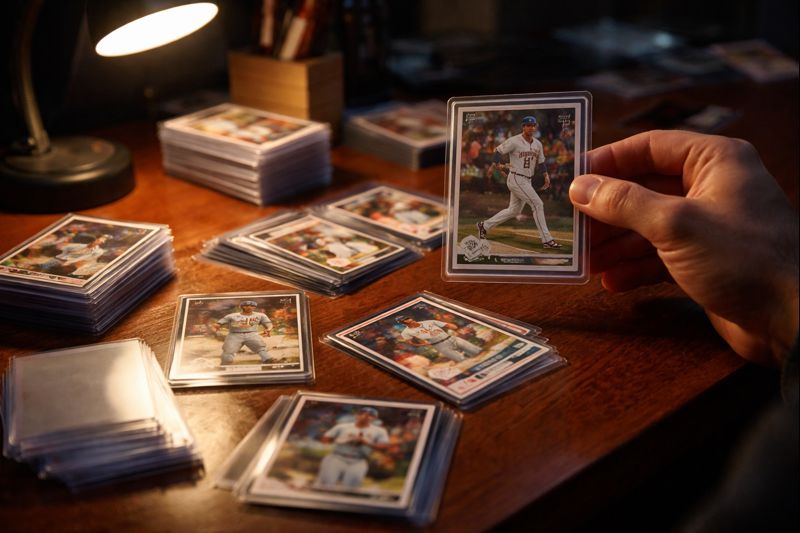
It’s late, and I’m staring at piles of cards spread across my desk. Max Scherzer. Justin Verlander. Clayton Kershaw. Future Hall of Famers, every one of them. And I’m completely paralyzed trying to decide which cards deserve a top loader and which ones get penny-sleeved and boxed.
This shouldn’t be hard. Top loaders cost me about six cents in bulk. The decision should be simple: protect the valuable cards, archive the rest.
But I keep picking up base cards—cards worth maybe fifty cents according to the market—and thinking, I want to protect this one.
That’s when it hit me: I’ve been letting other people tell me what my cards are worth.
The Three Forces of Collecting
Every collector operates at the intersection of three forces:
Market / Investment Logic
What a card is “worth” according to price guides, recent sales, scarcity, and speculation. This is what most hobby content focuses on.
Emotional Connection
What the card means to you. The player, the memory, the aesthetics, the moment it represents. Value that can’t be quantified.
Physical Reality
Space, budget, and time. You can’t top-load everything. Boxes fill up. Storage costs money.
Most of us are trained to let the first force dominate. We sort by book value. We protect expensive cards and feel vaguely guilty about protecting cheap ones. We internalize the market’s hierarchy as if it’s objective truth.
It isn’t.
Permission to Value Differently
Here’s what I realized sorting through those Kershaw cards:
I’m allowed to value a card more than I “should.”
Except I’m not actually valuing it more.
I’m valuing it differently than the market does—and those are not the same thing.
The market says:
“2016 Topps Kershaw base card = $0.99.”
I say:
“2016 Topps Kershaw base card, with that photo, capturing him at his peak = worth protecting.”
Neither valuation is wrong. They’re just measuring different things.
The market measures scarcity and demand.
I’m measuring personal significance.
The Kershaw Box Crisis
My Kershaw box is full. That forced a reckoning: get another box, or start cutting.
The “rational” move would be to sort by market value—keep the numbered parallels and rookies, downgrade the base cards. But when I actually started going through them, the decisions didn’t line up that way.
Some base cards still sparked something.
Some cards just didn’t register the same way.
I realized I’d been top-loading on autopilot—following market logic instead of trusting my own reaction.
I probably have base cards top-loaded that “serious collectors” would laugh at. And that’s fine. They’re not building my collection. I am.
The Practical Middle Ground
This isn’t about ignoring reality. Physical constraints matter. I can’t top-load every card I vaguely like. Space is finite. Even at six cents per top loader, it adds up.
The core cards—the ones that matter—aren’t getting demoted. When something earns real protection, it tends to stay there. The flexibility isn’t about moving everything around; it’s about not overthinking the edges.
You can protect a card now and later decide it didn’t deserve that level of care after all. You can revisit a box months from now and realize something belongs closer to the surface. The collection evolves—not by weakening the center, but by refining the margins.
What This Looks Like in Practice
Tonight, I stopped asking, What’s this worth?
And started asking, Do I want to protect this?
Some base cards went into penny sleeves and boxes.
Some base cards got top-loaded because something about them resonated.
I don’t have a formal system. No dollar threshold. I just respond to what each card means to me in the moment. Some nights I’m more selective. Some nights more generous.
That’s okay.
The goal isn’t perfect consistency.
It’s building a collection that reflects what I actually care about.
The Permission You’re Looking For
If you’re reading this and thinking about your own collection—the cards you’ve protected “wrong,” or the ones you feel guilty about keeping—here’s what you need to hear:
You’re allowed to value cards based on emotional connection, not market price.
You’re allowed to top-load a base card because you love the photo.
You’re allowed to change your mind later.
Your collection exists for you, not for the market. Build it accordingly.
Where I Landed
I’m getting another Kershaw box. The audit can wait. Maybe I’ll consolidate later. Maybe I won’t. Right now, having the cards I care about protected and accessible matters more than proving I can be ruthless about curation.
And those base cards I top-loaded tonight?
They’re staying that way.
Not because the market says they should.
Because I decided they should.
That’s enough.
 El Cardquistador
Leave a comment