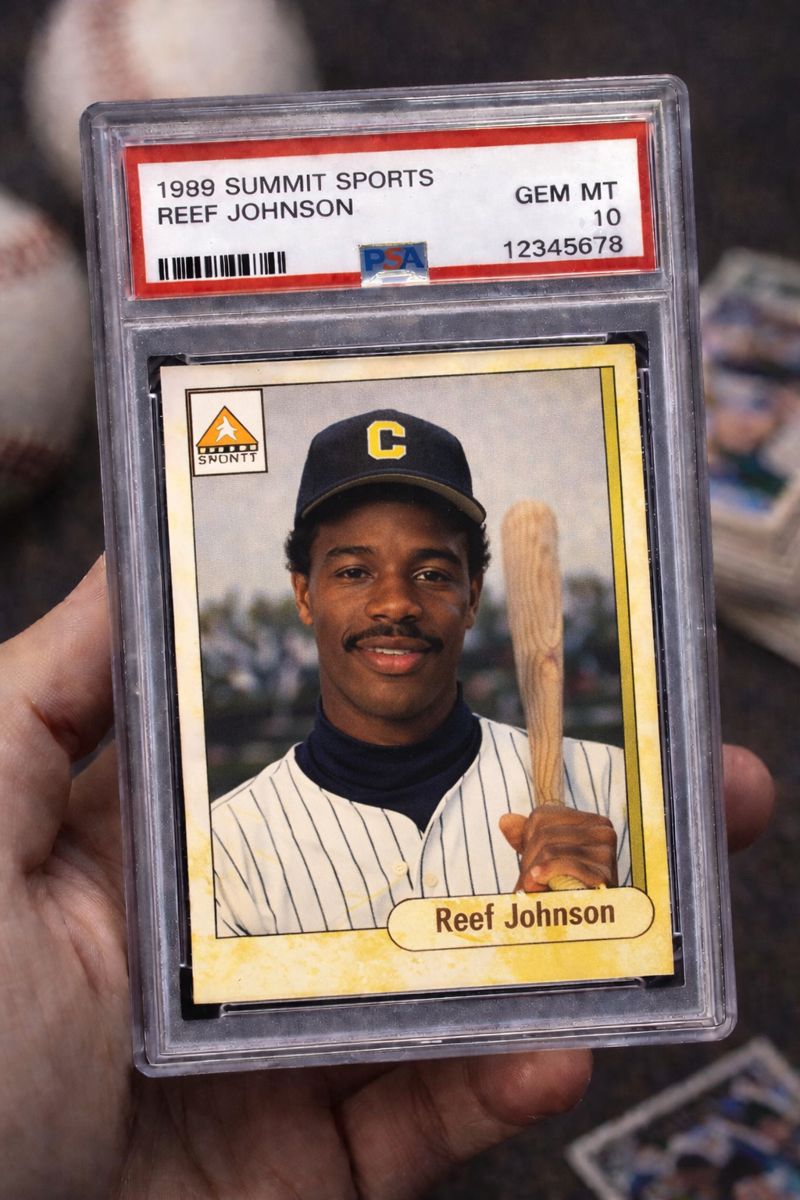
Grading companies provide a service. They authenticate cards, assess condition, and create a standardized language for buying and selling. That’s useful. What’s not useful is when collectors stop using their own eyes and defer entirely to whatever number appears on a plastic slab.
The grade is a guide. It’s an opinion. And like all opinions, it can be wrong, it can change, and it definitely shouldn’t be the only thing you look at when evaluating a card.
When the Grade Doesn’t Match Reality
I own a 1997 Topps Gallery Players Private Issue Darryl Strawberry card. It’s one of 250 made specifically for Strawberry himself – cards that were given directly to the player. HGA graded it a 9.5 overall, with individual subgrades including a perfect 10 for edges.

Here’s the problem: the edges aren’t a 10. You can see chipping on the top right corner and along the right edge. It’s right there in the photos. HGA said 10. My eyes say otherwise.
Now, I bought this card anyway – not because of the grade, but because it’s a Players Private Issue Strawberry card. The provenance matters more than the number. But imagine buying this online, trusting the “10” on edges, and then receiving it only to see what’s actually there.
This is why you look at the card, not just the slab.
Cards Change. Grades Don’t.
Here’s another reality collectors need to understand: cards continue to age inside slabs. The plastic doesn’t stop time.
Take a look at this 1990 Score Bo Jackson – one of the most iconic images from the junk wax era. It was graded PSA 8 at some point. But look at it now. The borders are yellowing, particularly visible on the right side and bottom. That card was an 8 when PSA slabbed it. It’s not an 8 anymore.

The grade on the label is frozen in time. The card itself is not. UV exposure, environmental conditions, and simple oxidation don’t care about the plastic case. If you’re buying based solely on the number without examining the actual card, you might be getting something that no longer matches what you paid for.
When a Lower Grade is Actually Better
Now look at these two Bo Jackson cards – same card, same iconic image, different grades. One is a PSA 8. One is a PSA 7.
The PSA 7 looks better. Significantly better.
The borders are cleaner and whiter. There’s no yellowing. The card is in objectively superior condition to the higher-graded version. Yet if you only looked at the numbers, you’d assume the 8 was the better card and likely pay more for it.

This can happen for multiple reasons: grading inconsistency between submissions, one card degrading after being slabbed, or simply human error in the grading process. But the result is the same – the number doesn’t tell you what you’re actually getting.
You have to look at the card.
What Grading Is Actually Good For
None of this means grading is useless. Authentication matters, especially for vintage cards and high-dollar purchases. Having a third party verify a card is real provides peace of mind. Grading also creates a common language for remote transactions – it’s easier to sell a card you can’t physically show someone when there’s a standardized assessment.
But grading companies are guides, not gods. Their opinions have value, but they’re not infallible. They make mistakes. Their standards aren’t perfectly consistent. Cards change over time even in slabs. And different companies have different standards, making cross-company grade comparisons meaningless.
Your Eyes Matter More
The current collecting culture has it backwards. Too many collectors buy grades and tolerate whatever card happens to be inside. They chase PSA 10s of players they don’t care about because the number is pretty. They overpay for slabs without examining the actual card. They trust the label more than their own judgment.
That’s not collecting. That’s speculating on plastic.
I collect Darryl Strawberry cards. I’ve got hundreds of them. Some are graded, most aren’t. The graded ones aren’t more important to me than the raw ones. A PSA 10 base Topps isn’t more meaningful than an oddball issue I finally tracked down. The Players Private Issue card with the questionable edge grade is one of my favorites precisely because of its story – it was made for Strawberry, given to Strawberry, one of only 250. The HGA grade is just the container it came in.
When I look at my collection, I see cards – not numbers. Players, moments, designs, and stories. The grade is metadata. It’s not the thing itself.
The Bottom Line
Grading companies provide assessments. Those assessments are useful data points. But they’re not substitute for your own examination, your own judgment, and your own priorities as a collector.
Before you buy based on a grade, look at the actual card. Check the centering yourself. Examine the corners and edges. Look for surface issues, print defects, or signs of aging. Compare it to other examples if you can.
The slab is just the container. The card is what you’re actually collecting.
So look at the damn card.
 El Cardquistador
Leave a comment