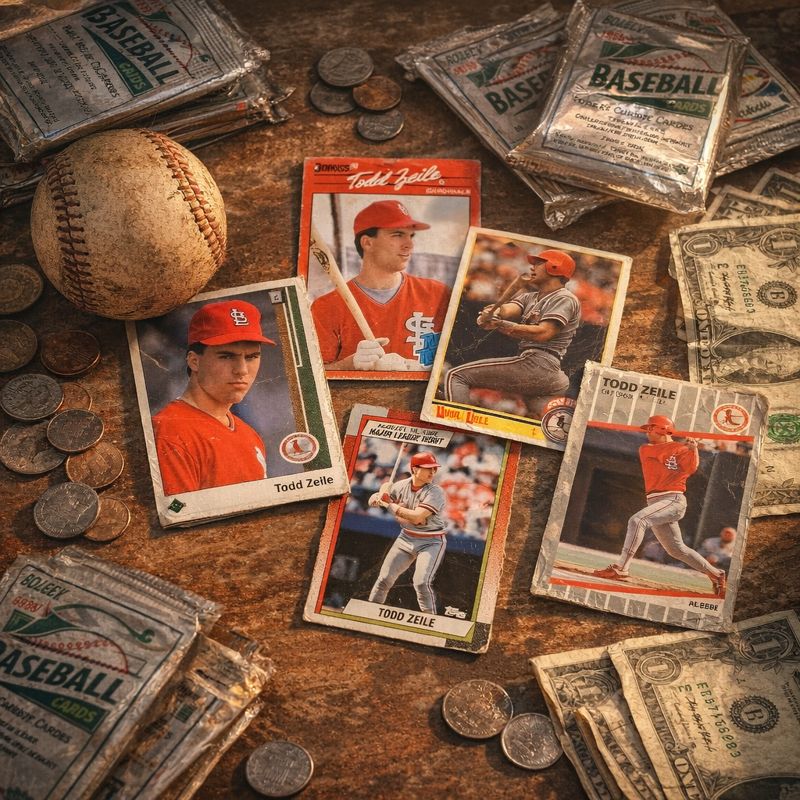
For years, Todd Zeile was the butt of my jokes.
He became shorthand for everything wrong with junk wax hype—the overpromised rookie who didn’t fund a retirement, didn’t anchor a collection, and didn’t turn into Ken Griffey Jr. or Frank Thomas. His name landed easily in the same sentence as dashed expectations and glossy cardboard lies.
And for a long time, that felt fair. But eventually, you’re forced to confront an uncomfortable truth: Todd Zeile wasn’t a joke. The expectations were.
The Sin of Arriving Crowned
Zeile’s problem wasn’t that he failed; it’s that he arrived pre-labeled as something he was never going to be.
In 1989, Upper Deck changed the world with high-gloss paper and holograms. On that checklist, sandwiched between names like Griffey and Sheffield, was Todd Zeile (Card #754). The hobby didn’t just want a hitter; they wanted the “Next Great Catcher”—the heir to Ted Simmons.
When Cardinals manager Joe Torre moved him to third base to save his bat (and his knees), the hobby didn’t see a strategic career-extending pivot. They saw a concession. In the rigid, high-stakes world of “Star Rookies,” a position change looked like a crack in the pedestal. Late ’80s cardboard framed him as a franchise cornerstone; when he didn’t become a first-ballot immortal, the hobby did what it always does: it rewrote “very good professional” as “bust.”
Strip Away the Cardboard
Remove the rookie card economy and the hobby mythology, and Zeile’s career looks a lot different. He wasn’t a failure; he was liquid currency.
- The 2,000 Hit Milestone: Zeile finished with exactly 2,004 hits. In the history of Major League Baseball, only about 300 players have ever reached that mark. That puts him in the top 1.5% of everyone who has ever put on a uniform.
- The Power Steady-State: He launched 253 home runs. He didn’t have the 50-HR peak of a superstar, but he provided a reliable “thump” for 11 different franchises, becoming the first player in history to hit a home run for over ten different teams.
- The “Journeyman” Rebrand: We often use “journeyman” as a pejorative. For Zeile, it was a testament to his value. Teams didn’t trade for him because he was a punchline; they traded for him because he was a professional who could stabilize a clubhouse. He was a piece that winning teams—including the 2000 pennant-winning Mets—desperately wanted.
The Tony Phillips Test
Here’s where the realization finally clicked. I’ve recently rediscovered Tony Phillips—and started praising him for exactly the things the hobby once trained us to overlook: longevity, versatility, and staying useful as tools faded.
And suddenly it became obvious: Todd Zeile was basically everything I now praise Tony Phillips for. Same type of value. Same kind of career. Same contribution to the actual machinery of baseball.
The only difference? Phillips arrived quietly and earned respect upward. Zeile arrived on a $2.00 premium Upper Deck card and had to live expectations down.
The Hobby’s Accounting Problem
The junk wax era taught an entire generation a toxic equation: Rookie Card + Hype = Destiny.
When destiny didn’t show up, the player took the blame—not the system that sold the fantasy. We were taught to value players as stock options rather than craftsmen. In that world, overachievers become cult heroes, quiet contributors get ignored, and anyone who fails to meet an inflated promise becomes a punchline.
The real villain isn’t the guy who collected 2,000 hits. The villain is the 1989 marketing machine that told us a 23-year-old catcher was a “can’t-miss” investment. Zeile didn’t underperform baseball’s needs; he underperformed cardboard’s promises.
So Do the Jokes Stop?
They don’t have to—but they should aim better.
The real punchline was never Todd Zeile. It was the idea that a long, productive, adaptable career somehow meant disappointment. Zeile belongs squarely in the group I keep returning to: the 98% who actually sustain the game.
Once you see that, the joke loses its bite—not because it wasn’t funny once, but because it wasn’t aimed at the right target.


 El Cardquistador
Leave a comment