Collectors deal with opportunity cost constantly, even if we don’t always call it that.
Most of the time the stakes are small. We do it with everyday cards. I’ll grab that next week. Maybe I don’t really need that one. In a live auction we may make dozens of these micro-decisions in an hour — bid or pass, chase or wait.
Usually those choices don’t matter much. There will be another copy. Another auction. Another opportunity.
But every once in a while the stakes are different.
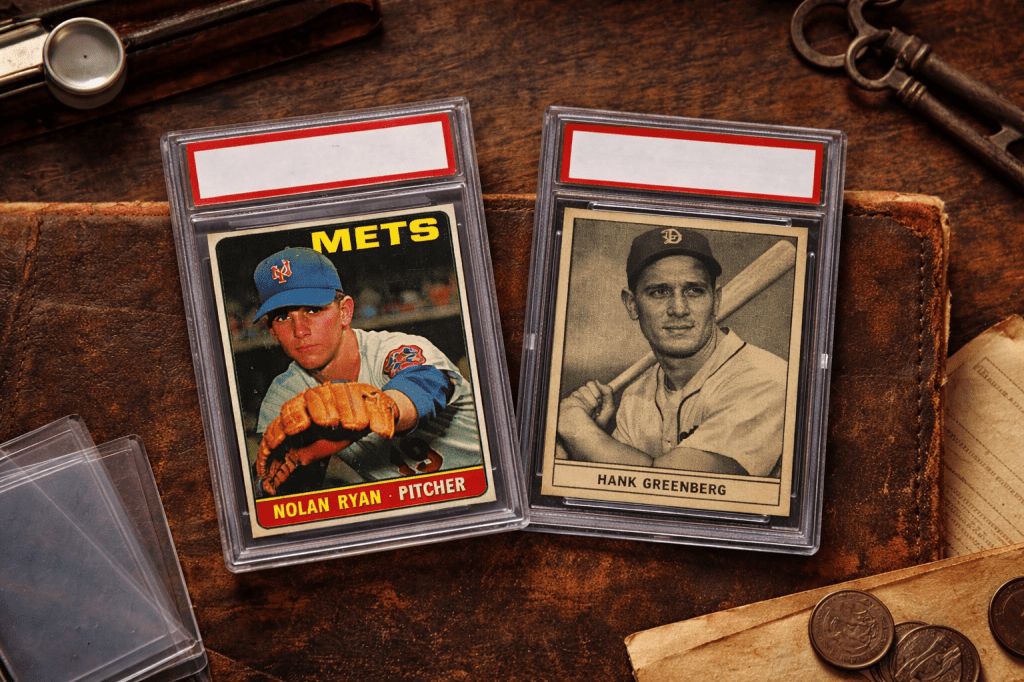
Recently I found myself in that situation. I had the financial opportunity to purchase one grail card, but realistically only one. The choice came down to two cards I’ve wanted for a long time: a 1969 Topps Nolan Ryan or a 1941 Play Ball Hank Greenberg.
I should probably acknowledge something here. A 1969 Topps Nolan Ryan and a 1941 Play Ball Hank Greenberg aren’t massive grails to every collector. I’m not deciding between two $4,000 cards, or two $50,000 cards. But every collector has a point where a purchase becomes a “take a breath and think about it” moment. For me, these are those cards.
Both cards checked a lot of boxes for me. Ryan is one of the defining pitchers in baseball history, and the 1969 Topps card sits right on the edge of vintage and the expansion era that helped shape the modern game. Greenberg, of course, carries enormous historical weight — a Detroit legend and one of the most important players of his era.
Either card would have been an easy choice if the other one didn’t exist.
And that’s where opportunity cost really shows up in collecting.
The stress of the decision actually had me considering walking away from both cards entirely. Sometimes when collectors are faced with two big decisions, the easiest way out is simply to make neither.
But thinking about it more carefully, the market itself helped guide the choice.
Ryan prices have been showing some upward momentum lately. Greenberg cards, on the other hand, have remained relatively stable. That made the opportunity cost of passing on the Ryan feel higher. If I let that card go, it might be harder to circle back later.
The Greenberg, while still a grail for me, felt like a card that would likely still be waiting down the road.
Then the right deal on a 1969 Topps Ryan appeared, and the decision more or less made itself.
Collectors like to imagine grail cards as singular moments — the one big card we finally land after years of waiting. In reality, the hobby often presents them differently. Sometimes the challenge isn’t finding the grail.
It’s choosing which grail comes first.
I’m confident the 1941 Play Ball Hank Greenberg will find its way into my collection someday.
For now, though, I think I can sleep just fine with the decision I made.
 El Cardquistador
Leave a comment