How Baseball Builds Villains So It Doesn’t Have to Answer for Itself
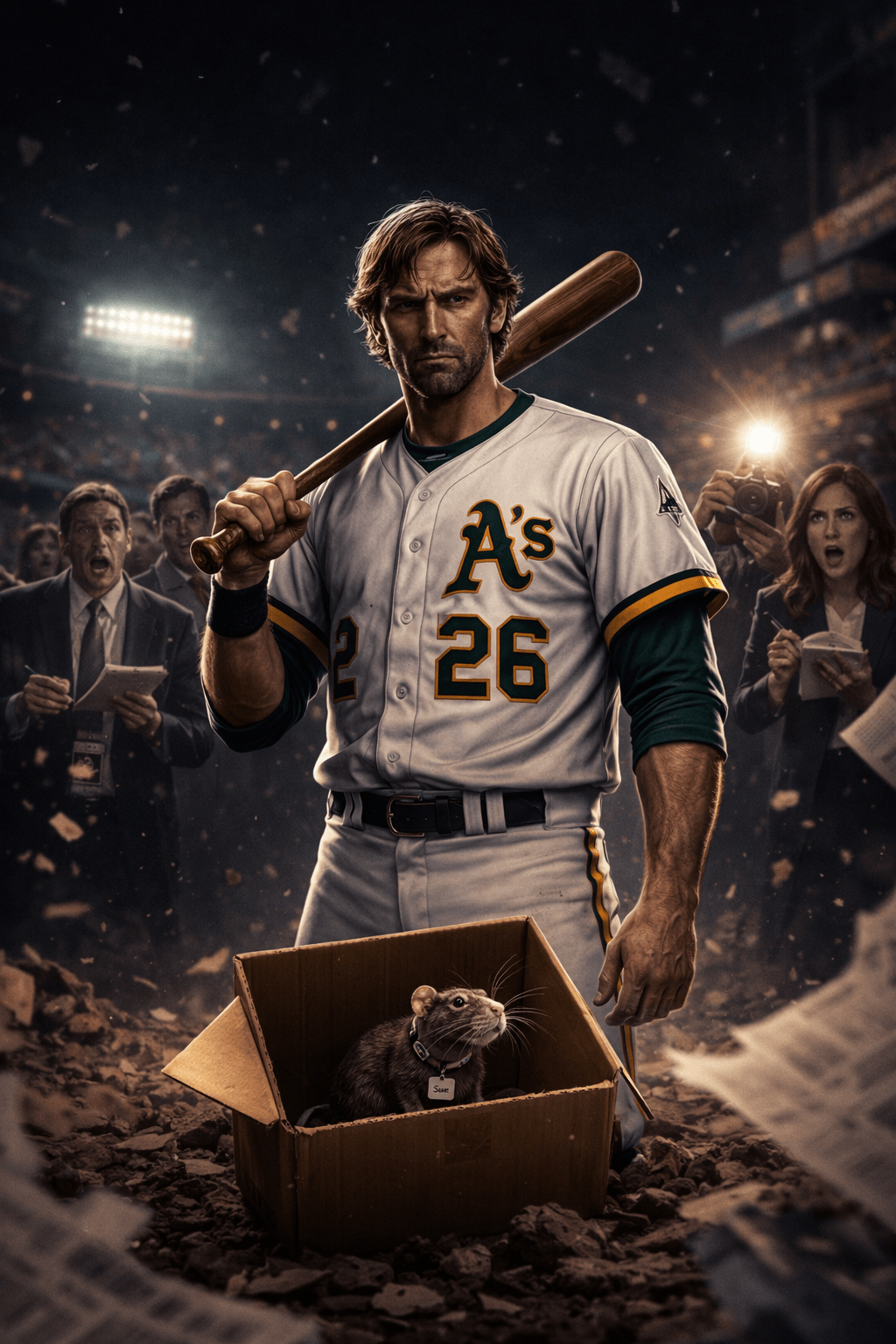
Dave Kingman was a jerk. This is not seriously in dispute. He was cold to fans, hostile to the press, a difficult teammate, and in 1986, he sent a live rat to female sportswriter Susan Fornoff while both were with the Oakland A’s. The rat had a tag reading, “My name is Sue.” When asked about it, Kingman described it as a prank and did not apologize. He later displayed supportive letters around his locker.
He was, in short, an easy man to condemn.
And that’s exactly the problem.
What We Do With One Man
There is a particular comfort in the singular target. One man, one set of acts, one verdict. We hold the trial, we render judgment, we move on. The moral accounting feels complete because it has a face on it.
What it almost never has is a broader reckoning with the culture that produced the man.
Kingman didn’t invent hostility toward reporters. He didn’t invent the adversarial relationship between players and the media. He didn’t invent the clubhouse culture that treated female journalists as an intrusion. He absorbed all of that from fifteen years of professional baseball and expressed it with a completeness — and a lack of internal governor — that made him unique not in kind, but in degree.
Most of his contemporaries ran the same fuel at a lower temperature. We remember them differently.
The Exhibit vs. The Villain
Consider what it would actually mean to indict an entire generation of ballplayers for the treatment of women in clubhouses in the 1970s and 80s. You would be implicating Hall of Famers. Beloved figures. The game itself — ownership, front offices, even members of the press corps who normalized the environment by participating in it without comment.
That’s a much harder case to make than “Dave Kingman was an asshole.” So we make the easier case. We load the condemnation onto the one man who gave us the most obvious target, and we call the accounting settled.
Kingman becomes less a villain, in this reading, than an exhibit. Here is what that culture produced when it ran to completion in a single human being with no natural corrective. Most men encountered friction that rounded off the sharpest edges. Kingman apparently got almost none. So he kept going in the direction the permission structure pointed him until he did something indefensible — and then couldn’t understand why people were upset.
Exhibits are more useful than villains. Villains you dismiss. Exhibits you have to actually look at.
The Robinson Problem
This cuts in a direction that makes people uncomfortable, so let’s go there directly.
The players who made Jackie Robinson’s first years a sustained exercise in institutional cruelty are largely remembered as products of their environment. Deeply wrong, but not uniquely evil. Men shaped by a profoundly racist society who acted in accordance with values they’d absorbed their entire lives. We contextualize. We understand formation.
And yet, those men committed a greater wrong. Their sin was structural and generational, causing damage that rippled across decades. Kingman’s sins were personal, petty, and specific.
We are, in practice, more forgiving of the former than the latter. We contextualize the generation and condemn the individual. Which is almost precisely backwards if the goal is understanding how culture produces behavior rather than just finding someone to blame.
Condemning a generation requires condemning people we love. It implicates icons. It requires the game to look at itself. Condemning Kingman requires nothing from anybody. He had no mythology protecting him, no legacy organization invested in his reputation, and he handed us a rat in a box.
He was made for the role.
What the Rat Actually Was
Here’s the honest version of Kingman: he was a man built for one singular act — hitting a baseball an inhuman distance — who was then required to exist inside a social ecosystem that demanded warmth, engagement, patience, and accessibility.
That produced friction. And rather than manage the friction, he aimed it at the people with the least institutional power and the most legitimate reason to be there.
The introvert argument explains the shape of the hostility. It does not excuse the rat. But you can see the through line — a man marinated for years in “reporters are the enemy” and “women don’t belong here” will eventually express that in escalating ways. The rat wasn’t random. It was the logical endpoint of a permission structure.
What made it indefensible wasn’t that it was unprecedented. It’s that even by the standards of 1986, it landed wrong immediately. Other players distanced themselves. The organization was embarrassed. The condemnation was real-time.
He just didn’t care. And that — more than the act itself — is the tell.
The Institution Always Walks
Pete Rose carries the entire gambling condemnation, while gambling existed in baseball long before him. Barry Bonds carries the steroid era in public memory, while other players connected to performance-enhancing drugs received Hall of Fame support and media careers.
The pattern holds even in the game’s darkest hours: Shoeless Joe Jackson remains the permanent face of exile, while the owner who ignored the fix is in the Hall of Fame, and the teammates who brokered the deal have been largely forgotten by a public that only has room for one villain.
The pattern is consistent: baseball needs singular villains because the alternative is implicating the game itself. Give people one face to condemn, and they’ll take it. It resolves the discomfort. It closes the loop.
The flip side is the singular hero. Making Jackie Robinson’s story primarily about Robinson’s extraordinary grace — which was real and earned — also functions as institutional protection. It becomes a story about one remarkable man rather than a story about what the game was, who built it that way, and who maintained it.
Hero and villain serve identical narrative purposes. Both let the institution off the hook.
The Singular Target
Dave Kingman was a jerk. That part’s true. But he was a jerk built from materials the game provided, running on fuel the culture supplied, in a direction nobody corrected until he’d already been doing it for fifteen years.
We made him the story so we didn’t have to tell the real one.
442 home runs. Three Hall of Fame votes in his first year of eligibility. The writers he spent his career tormenting got the last word.
In baseball, they usually do.
 El Cardquistador
Leave a comment