The Joy of Not Knowing What You’ll Find
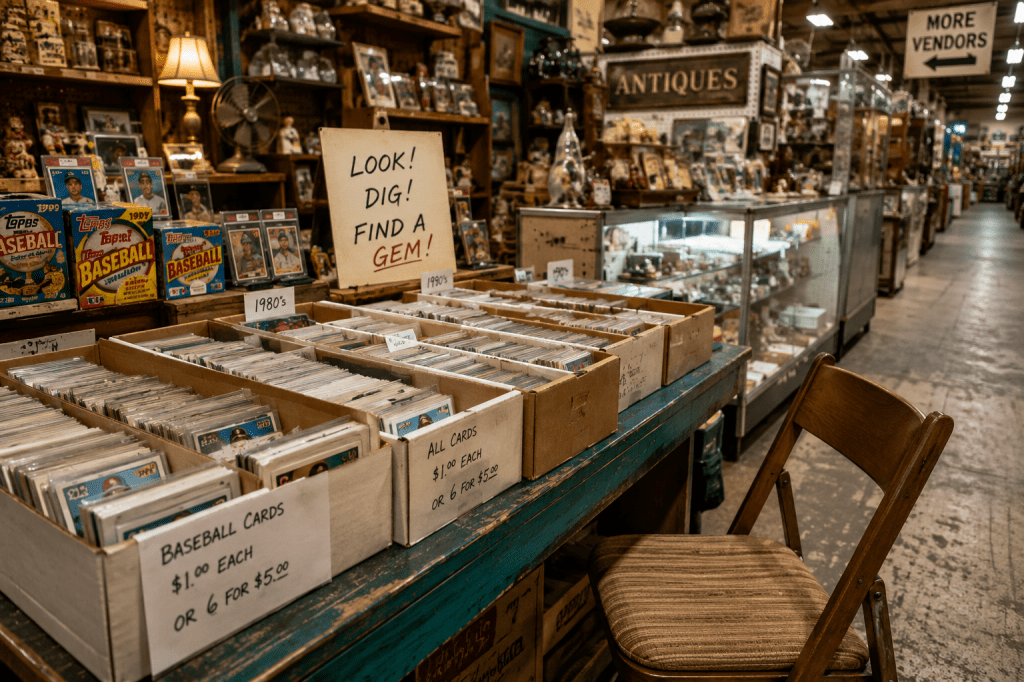
There is something genuinely compelling about walking into a multi-vendor antique mall as a card collector.
You are probably not going to find anything earth-shattering. Most of the time, you are going to find old furniture, glassware, records, comic books, loose toys, and a few scattered boxes of cards someone dragged in from a closet. But that uncertainty is the whole point.
It is the same instinct that makes you flip through a dollar box at a card show. You are not expecting much. You are not walking in with a checklist and a five-point acquisition strategy. You are simply open to being surprised.
And sometimes, you are.
I have pulled a Lee Smith rookie out of a value bin for three dollars. A Dave Henderson rookie for a buck. Seventies Keith Hernandez cards. Post-playing-days oddballs. Regional issues I never would have thought to search for online. The kind of cards you do not know you want until they are already in your hand.
That is the antique mall doing what it is supposed to do.
It creates serendipity.
Weird Pricing Comes With the Territory
The pricing, of course, is all over the place. I have made peace with that. If a card should be two dollars and it is marked three, fine. I will pay the extra dollar for the local convenience and the fun of the find. I am not driving across town or waiting a week to save a buck on a Lee Smith rookie.
But then you see a 1990 Score complete set tagged at twenty-six dollars. Or a rack of 1990 Donruss packs at three dollars each. And all you can really do is chuckle.
That is part of the ecosystem too.
The vendor may not know. The vendor may not care. Or the vendor may be waiting for the buyer who does not know, or care, either. And in most of these places, haggling is not really part of the experience. The vendor is not standing there. The store employee is not going to track someone down over a three-dollar card.
If the price works, you buy it. If it does not, you move on.
That is the deal.
Mispriced stuff is part of the antique mall card hunt. You just have to be the one who knows the difference.
Let Me Look at the Damn Cards
But bad pricing is not the real problem.
The real problem is when the cards are there, the buyer is there, the interest is there, and the booth makes it miserable to actually look through them.
A value bin only works if you can dig through it.
That sounds obvious, but apparently it is not. I have seen value bins set inside cases at knee height. I have seen boxes shoved against walls at weird angles where you need to bend sideways just to see the first row. I have seen cards placed so low that the only realistic way to browse them is to kneel on a concrete floor and pretend your back is not filing a formal complaint.
And then there is the worst version: the locked glass case.
You see a box of cheap cards. You want to look. But first you have to flag down a store employee. Then the employee has to find the key. Then they unlock the case. Then you stand there digging through cards while another human being hovers nearby, watching you like you are defusing a bomb.
That is not a buying experience.
That is a hostage negotiation with 1989 Donruss.
You do not buy more under those conditions. You buy less.
Sometimes you buy nothing.
The Chair Is the Whole Business Plan
This is not only an antique mall problem, either. Card shops do it too. Put a low-value box behind glass or down near the floor and people glance at it, decide it is not worth the trouble, and move on. Put the same box somewhere open, accessible, and comfortable, and people linger.
When people linger, they buy.
I can prove this with two local stores.
One antique mall has a vendor who leaves a chair next to their card booth. A chair. That is it. Nothing fancy. Nothing revolutionary. Just a place to sit.
So I sit down. I dig. I lose track of time. I start with the intention of buying two or three cards and walk out with a stack. It happens every single time. The vendor made it easy for me to spend money, so I spent money.
Another vendor in that same store has everything locked up. I barely bother with that booth anymore. There might be good stuff in there. There probably is. But the booth has trained me to keep walking.
A second store has one vendor with open, accessible bins while most of the others keep everything sealed up tight. Guess which vendor I spend time with? Guess which vendor gets my money?
This is not complicated.
A chair. An unlocked bin. Good light. Twenty minutes of uninterrupted digging.
That is the entire formula.
A Value Bin Is an Invitation, Not a Museum Exhibit
These vendors sometimes have genuinely good stuff. That is what makes it frustrating. The cards are there. The buyers are there. The interest is there. But the system is built in a way that makes it harder than necessary to complete the most basic transaction in collecting:
I look through cards. I find cards I like. I give you money.
A value bin is not fine china. It is not a museum relic. It is not a sacred object that needs to be protected from human contact. It is an invitation to dig.
So treat it like one.
Put the cards where collectors can reach them. Give them enough light to see what they are buying. Do not make someone kneel on concrete to look through junk wax. Do not lock three-dollar cards behind glass like they are the Declaration of Independence.
And if you really want to be dangerous, put a chair next to the box.
The hunt is half the fun.
But you have to actually let people hunt.


Leave a comment