How About You Say Hello First?
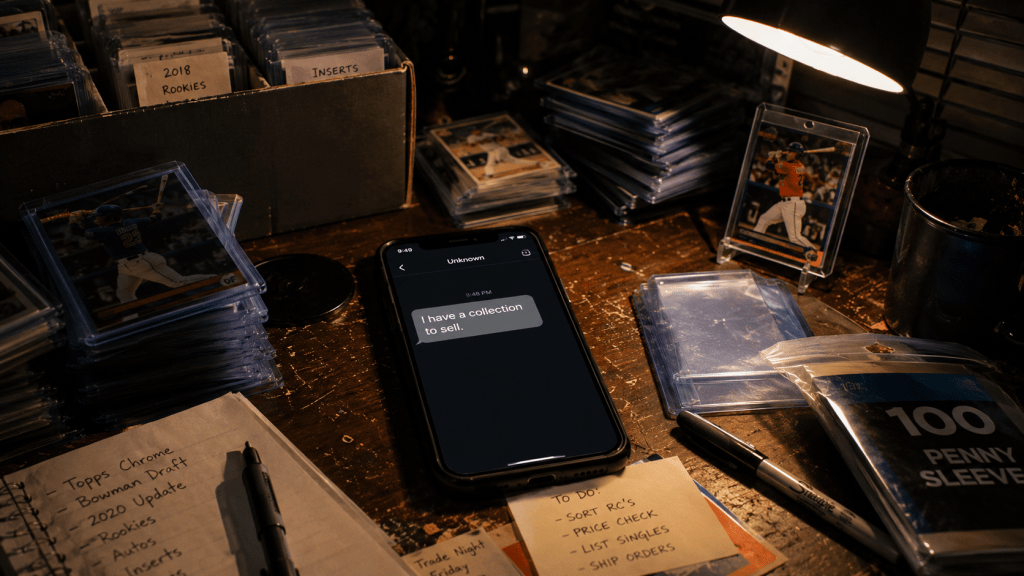
That was my reaction when a stranger followed me on Instagram and immediately offered me a card collection to buy.
No introduction. No context. No “hey, I like your page.” No “I noticed you collect oddball stuff.” No basic attempt to connect with the person behind the account.
Just straight to the transaction.
That is the part that bothered me.
Not the existence of the offer. Not the fact that someone had cards to sell. Not even the idea that someone might think I would be interested.
I buy cards. I talk about cards. I post cards. I clearly have cardboard disease.
But I almost never buy cards from Instagram cold. When I do buy through Instagram, it is usually from people I have known for a while. People I have talked to. People with some history. People where there is at least a relationship, a reputation, or a reason to believe the deal is real.
Because Instagram is not eBay. It is not Whatnot. It is not a card show table. There is no built-in feedback system. No seller rating. No transaction history sitting there for me to review. No platform mechanism that makes me feel like the person on the other end has been vetted by more than a profile picture and a few posts.
So when someone appears out of nowhere and immediately wants to move into a transaction, that is not just socially awkward. It is asking me to accept risk without trust.
But there is a way these things are done, and that was not it.
This Is Not Me Being Precious
This is not about thinking I am special. It is not about saying I cannot be approached. It is not about acting like my Instagram account is some sacred temple of cardboard. It is just basic hobby etiquette.
Check the room before you start pitching.
There are accounts that openly say they are buying collections. There are dealers, shops, flippers, consignment pages, and inventory hunters. There are accounts whose bios basically say, “Send me what you have.” Those people have hung the sign in the window.
I have not.
My account is not a buying desk. It is not a liquidation counter. It is not an intake form. It is not a place where a stranger can walk in, drop a box on the table, and expect me to start doing mental math.
It is a hobby account.
A place where I share cards, thoughts, jokes, oddball finds, and whatever else the cardboard brain drags in that day. There is a personality to it. There is a lane to it. There is a vibe to it.
So maybe check the vibe first.
The Problem Is the Jump
The issue is not that I cannot be approached. The issue is not that nobody can ever offer me something. The issue is being treated like a transaction before being treated like a person.
That is what makes it feel wrong.
It has the same energy as a door-to-door salesman. The product might be real. The offer might be legitimate. The person might not be trying to scam anyone. But the intrusion is still the intrusion.
A salesperson at a card show table makes sense. That is the environment. Everyone knows what the room is for. Money is expected to change hands. Cards are on display. Prices are being discussed. Offers are being made.
But when someone knocks on your door at dinner, the same basic sales pitch feels completely different.
Context matters.
Trust matters.
Approach matters.
Access Is Not Permission
Instagram is strange because it blurs all of that. It is public, but it still feels personal. It is social, but it is also commercial. It is a hobby space, but the hobby has money in it. That mix makes people forget that access is not the same thing as permission.
Just because someone can DM you does not mean they have earned your attention.
Just because someone sees you collect cards does not mean you are now their exit strategy.
Just because someone has a collection does not mean you are obligated to become a buyer, appraiser, negotiator, or disposal service.
And I think that is where some of the frustration comes from in the hobby. Collectors get treated like wallets with usernames. If you post cards, people assume you are buying. If you know cards, people assume you owe them free expertise. If you have any kind of visible presence, people assume they can skip the relationship and go straight to the ask.
But the relationship is the whole thing.
Nobody Needs to Send Flowers
That does not mean every interaction has to be some long courtship. Nobody needs to send flowers before offering a 1978 Burger King Mark Fidrych. But there should be some basic sign that you know who you are talking to.
“Hey, I saw you collect oddball stuff and thought this might be up your alley.”
That is different.
“Hey, I have some Tigers cards and remembered your page.”
That is different.
“Hey, I know you are not a dealer, but I have something weird and wanted to see if it was worth sending over.”
That is different.
Those messages at least acknowledge the person on the other end. They show some awareness. They make the approach feel human instead of extractive.
The cold pitch does the opposite.
It says, “I do not know you, but I want something from you.”
And maybe that sounds harsh, but that is the feeling. It is not community. It is not connection. It is not even really networking. It is just a transaction looking for a target.
Blocking Is Sometimes Maintenance
That is why blocking did not feel dramatic to me. It felt like maintenance.
We curate our collections. We curate our feeds. We curate our spaces. Sometimes that means deciding what does not get to come in.
I am not mad that someone wanted to sell cards.
I am not mad that someone thought I might buy cards.
I am saying: read the room.
Look at the account. Look at the posts. Look at the bio. Look at the tone. Figure out whether this is a buying desk or a person sharing a hobby.
And if you still want to approach?
Start like a human being.
Say hello first.


Leave a comment