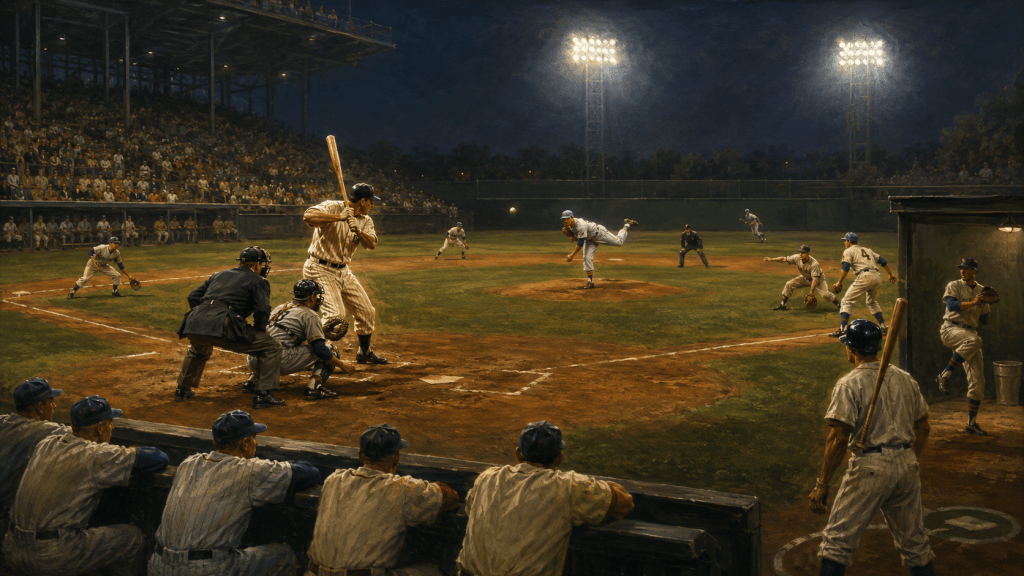
I have this baseball thought I come back to a lot and I know I’ve said it plenty of times:
Hall of Fame players had to play somebody.
That sounds obvious, but I think it matters more than people realize. We talk about the legends like they existed on a separate plane, like they spent their careers performing greatness in isolation. Mantle. Mays. Aaron. Seaver. Bench. Rickey. Griffey Jr. The names get bigger with time, and they should.
But they did not play against air.
They played against a league full of professionals. Not just other Hall of Famers. Not just future plaques. They played against very good players, useful players, strange players, specialists, grinders, utility guys, glove-first shortstops, backup catchers, fourth outfielders, fifth starters, and middle relievers trying to get through the sixth inning with a one-run lead.
That is the real backbone of baseball.
The Ultimate Fantasy League
And it leads to a fun question:
What if every player was Hall of Fame caliber?
What if every starting pitcher was Nolan Ryan, Tom Seaver, Bob Gibson, or Greg Maddux? What if every catcher was Johnny Bench, Gary Carter, Yogi Berra, or Pudge Rodriguez? What if every leadoff hitter was Rickey Henderson? Every center fielder was Ken Griffey Jr., Willie Mays, or Mickey Mantle. Every corner bat was Hank Aaron, Barry Bonds, Frank Robinson, or Ted Williams.
At first, that sounds like the greatest baseball league ever imagined.
Then the math starts ruining the fantasy.
When Greatness Crashes Into Itself
Because baseball does not let everyone dominate at the same time. Every hit for a batter is a hit allowed by a pitcher. Every run scored by one team is a run charged to somebody else. Every home run is also a pitcher getting beat. Every stolen base is also a catcher, pitcher, or middle infielder losing that exchange.
The books have to balance.
So in an all-Hall-of-Fame league, the numbers would not look like everyone’s best Baseball Reference page at once. You would not have every hitter batting .340 and every pitcher carrying a 2.10 ERA. That cannot happen. The greatness would crash into itself.
The numbers would compress.
A .300 batting average might become rare. A .270 hitter might be excellent. A 3.50 ERA might be outstanding. A 25-homer season might mean real power. A .370 on-base percentage might be a monster season. A guy who looks ordinary on paper might actually be surviving against impossible competition.
That is the part I love.
Because it shows that baseball greatness is not just about raw totals. It is about context. It is about the league around you. It is about how much better you were than the other professionals who were already among the best baseball players alive.
The Infrastructure of the League
And that is where my real point lives.
There are not enough Hall of Famers to make baseball. There never were. There never will be.
The sport needs Tony Phillips.
It needs Pedro Guerrero.
It needs Chet Lemon.
It needs Bill Madlock, Buddy Bell, Frank White, Willie Randolph, Darrell Evans, Rusty Staub, Brian Downing, Toby Harrah, Lance Parrish, Dwight Evans, Bobby Grich, Amos Otis, Mark Belanger, and a thousand other players whose careers do not always fit neatly into plaque language.
Some of those guys have Hall of Fame arguments. Some do not. Some were stars. Some were almost-stars. Some were better than the hobby remembers. Some were the kind of player you only fully appreciate when you stop chasing only rookies, icons, and investment pieces and actually look at what they did year after year.
Beyond the Cardboard Archetypes
Tony Phillips is one of my favorite examples of this. He was not the clean, simple baseball-card archetype. He was not just “third baseman” or “left fielder” or “leadoff guy.” He was a baseball player. He got on base. He played everywhere. He helped teams win in ways that are easier to understand now than they were when a lot of us were first flipping through cards.
Pedro Guerrero was dangerous. Maybe not forever, maybe not in the way that makes casual fans recite his name automatically, but dangerous enough that pitchers had to care. For a stretch, he was the kind of hitter who changed the temperature of an inning just by walking to the plate.
Chet Lemon was exactly the kind of player who gets lost when history gets too plaque-focused. He covered ground in center field that most outfielders do not reach, made contact, hit for real power, and gave pitchers difficult at-bats. A center fielder who made teams better in every phase of the game, even if he does not get brought up enough when people talk about the shape of the era.
These players are not footnotes.
They are the structure.
The Scale of Greatness
The Hall of Fame is supposed to honor the greatest players. It should. But honoring the greatest players should not mean flattening everyone else into background scenery. The league was not made of stars and nobodies. It was made of layers.
That is what makes baseball beautiful.
You need the inner-circle legends. You need the Hall of Famers. You need the All-Stars. You need the very good. You need the useful. You need the guy who can play four positions. You need the catcher who can guide a bad starter through five innings. You need the veteran bat who makes a young pitcher sweat. You need the center fielder who turns doubles into outs. You need the second baseman who does not sell posters but turns the double play that saves the season.
Without those players, greatness loses its scale.
If every pitcher is Seaver, then Seaver becomes normal.
If every center fielder is Griffey Jr., then Griffey becomes the standard instead of the exception.
If every leadoff hitter is Rickey, then Rickey is not Rickey anymore. He is just what leadoff hitters are.
The Paradox of Perfection
That is the paradox.
If everyone is a Hall of Famer, nobody is.
The Hall would move. The line would reset. The argument would start all over again, just at a higher altitude.
And that thought experiment, as fun as it is, mostly reminds me why the real game is better.
The real game has contrast. It has stars, grinders, odd careers, platoon bats, defensive wizards, late bloomers, stat-sheet weirdos, and guys who were better than their card prices. It has players who were not legends but were absolutely necessary for legends to exist.
So yes, celebrate the Hall of Famers.
They earned it.
But do not talk about them like they played alone.
They had to play somebody.
And a lot of those somebodies were damn good.


Leave a comment