The Experiment
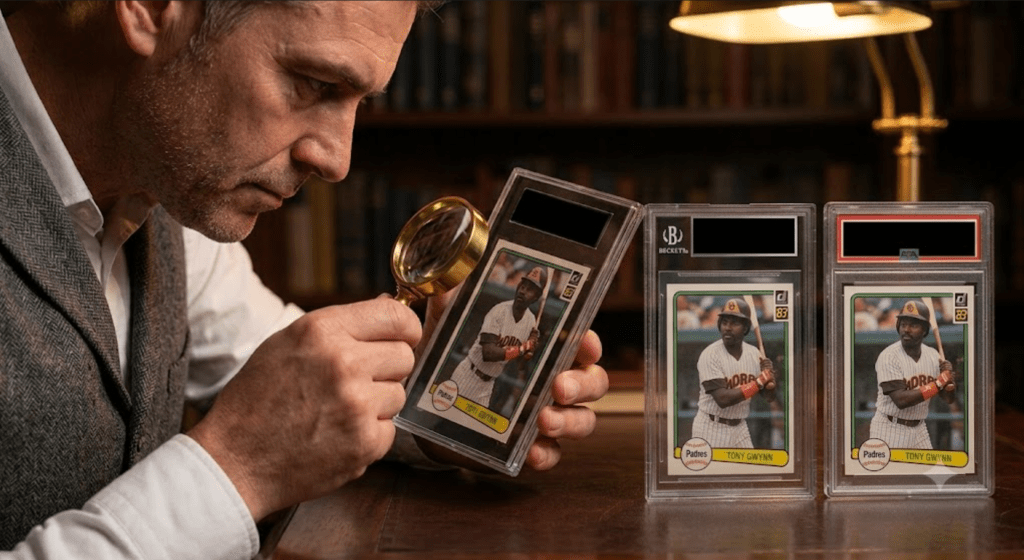
I ran a small experiment. I posted three 1983 Donruss Tony Gwynn rookies, each graded by a different company. I covered the grades. I told people up front that the cards were all very similar. Then I asked them to guess.
The real grades were tight, exactly like I’d said: a 9, a 9, and an 8.5.
The guesses weren’t.
Three Guesses
One commenter went low across the board — every number under the actual grade, none of the three within a point of the truth, delivered flat and confident, like a diagnosis rather than a guess.
Another got the first card exactly right — a 9, dead on. Then, card by card, the numbers dropped. By the third card, the guess was nearly two full points under the real grade. That one stuck with me more than the others, because it rules out the easy explanation. This wasn’t someone who couldn’t read a 9 — they proved they could, on the very first card. Somewhere between card one and card three, something other than the card itself started moving the number.
A third commenter just wrote, “That’s tough, they all look great” — and then guessed closer to the real spread than anyone else. They were also the only one who didn’t try to rank the three cards apart from each other.
Same three cards. No grades visible. No real audience to perform for beyond a comments section. And still, the guesses skewed harsh — and got harsher card by card, as if each new comparison gave someone another reason to tell the cards apart.
Not a Grading Company Problem
That result surprised me. I expected a grading-company bias — some sleeve carrying more trust than another. Instead, the pattern had nothing to do with which company graded the card. It was about what happened when a person sat with it and tried to find something wrong.
I ran the same setup on other cards too, different players, different grading company combinations — and the pattern held. Guesses consistently skewed harsh, no matter which companies graded the cards. The Gwynn rookies are just the cleanest example, because the actual grades landed so close together that the guesses had nowhere to hide.
Two Theories, Not Conclusions
So here are two theories. I want to be upfront that that’s all they are — theories, not conclusions I’m fully sold on. I’d genuinely like to know if you think I’m wrong, or if this rings true to you too.
Theory one: criticism is a way of performing expertise.
Anyone can say a card looks nice. It takes a trained eye to say it looks nice and find the flaw nobody else caught — the soft corner, the print dot, the sixteenth of an inch off-center. In a hobby built on tiny distinctions, finding the flaw is how you show you belong. The critical read becomes a kind of resume: I know what I’m looking at.
Theory two: someone else’s nice card can feel like a quiet threat to your own.
This one’s uglier, and it’s the one the second commenter’s guesses made me think about. If I own a high-grade card, some part of me wants that grade to mean something — to be rare, hard-earned, worth what it cost. So when I look at another card and think, there’s no way that’s a 9, I have to ask honestly whether I’m looking at the card, or protecting the specialness of my own. Not out of malice. Probably not even consciously. Just a quiet bit of math running in the background: if everything is a 9, is my 9 still special?
I don’t think either of these makes someone dishonest. I don’t think anyone posting a grade guess in a comment section is trying to tear another collector down. I think it’s mostly automatic — we sort things into categories without meaning to, and we want the things we value to stay valuable.
I’m Not Writing This From Outside It
And I’ll say plainly: I’m not writing this from outside it. I’ve caught myself doing both. I’ve reached for the flaw first because it felt like the more sophisticated read. I’ve looked at someone else’s card and felt something tighten a little, some instinct to find the reason it wasn’t quite as good as mine. That instinct doesn’t feel like envy in the moment. It just feels like having standards.
Why You Hate My Cards
The goal isn’t to stop being critical — a sharp eye is genuinely one of the things that makes this hobby fun to be in. The goal, I think, is just to notice the moment where the criticism stops being about the card and starts being about us.
A collector who’s actually good at this should be able to say: I see the flaw, and I also understand exactly why it graded the way it did — without needing the second part to cost them anything.
 El Cardquistador
Leave a comment